Advertisement
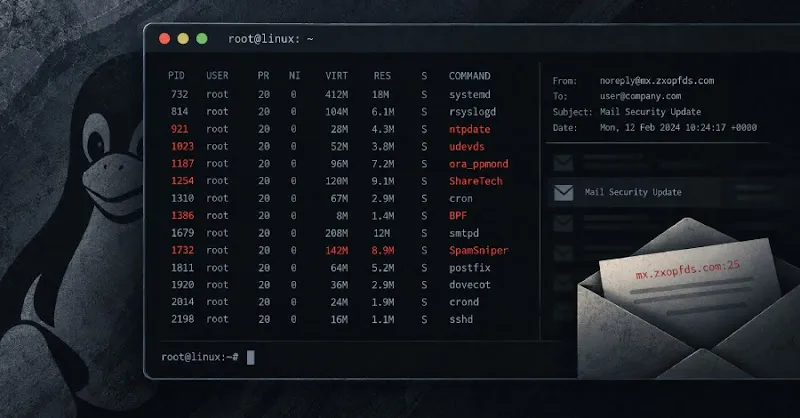
Linux Backdoors Target Telecom Networks with Regional Spoofing
Linux backdoors targeting South Korea and Taiwan disguise traffic as email security products to evade detection in enterprise environments.
ClingSTUN Linux Backdoor Exploits Dozens of Flaws via STUN Protocol
FortiGuard Labs identifies ClingSTUN, a Linux backdoor that abuses the STUN protocol and exploits dozens of flaws for self-propagation.
CVE-2026-61500: Rejetto HFS RCE via Weak Signing Key Flaw
Hackers are actively scanning for a critical RCE flaw in Rejetto HFS versions 3.0.0-3.2.0 (CVE-2026-61500), enabling session forgery and account takeover.

New Linux Backdoors Mimic Asian Mail Security Products
A trio of newly discovered Linux backdoors are mimicking legitimate Asian mail security products, making detection challenging for defenders.

SPIFFE/SPIRE Identity Misuse: Kubernetes Post-Exploitation
Discover how root access on a Kubernetes node enables workload identity spoofing in SPIFFE/SPIRE environments using the Spooffe tool.
MAccConc: Memory Access Concurrency Testing and Tracing Tool
Explore MAccConc, a new developer tool for testing and discovering Linux kernel race conditions using memory access tracing and stack delays.
Advertisement
North Korean Hackers Deploy New Linux Espionage Toolkit
North Korean state-sponsored hackers target automotive and media firms in South Korea using a custom Linux espionage toolkit.

Evooo1Bot Linux Botnet: Beyond DDoS with Exploits & Credential Theft
Evooo1Bot Linux botnet evolves, adding exploitation modules, credential theft, and SOCKS relays, transforming compromised devices into persistent attacker infrastructure.
TONTOU CPU Attack Bypasses Spectre v2 Mitigations on Linux
New TONTOU CPU attack bypasses Spectre v2 fixes on Intel and AMD, enabling unprivileged attackers to leak Linux kernel password hashes.
NatJack Attacks: Exploiting NAT Trust in Windows, Linux, macOS
Synack's research reveals NatJack attacks, a new class of NAT exploitation affecting Windows, Linux, and macOS, leveraging trust assumptions.
CVE-2026-64561: Zapscape KVM Flaw Allows Guest VM Escape
Analyze CVE-2026-64561, a KVM shadow MMU vulnerability dubbed Zapscape allowing L1 guest VM escape to Linux hosts. Learn mitigation steps.
SSH Botnet Reconnaissance Before Linux Cryptominer Deployment
An SSH botnet performs extensive hardware and system reconnaissance on Linux targets before deploying an optimized cryptocurrency miner. Weak credentials exploited.

UEFI Shim Bootloader Vulnerabilities: Secure Boot Blind Spot
Nearly a dozen vulnerable UEFI shim bootloaders remained trusted for years, allowing attackers to bypass Secure Boot for persistent malware and rootkit deployment.
Linux Process-Specific HTTP Proxying: Tools and Analysis Gaps
Explores the utility of process-specific HTTP proxying for Linux debugging and reverse engineering, highlighting the absence of a generic solution akin to Proxifier.
Linux Kernel Dirty Frag: CVE-2024-26610 LPE Vulnerability Analysis
Technical analysis of the Dirty Frag Linux kernel vulnerability (CVE-2024-26610), exploring its impact on IPv4 fragmentation and mitigation strategies.
Dirty Frag: Linux Kernel Zero-Day Enables Local Privilege Escalation
The Dirty Frag zero-day vulnerability allows local attackers to gain root access on major Linux distributions via an exploit in kernel fragmentation handling.

AI-Assisted Scan Uncovers 9-Year-Old Linux Vulnerability
An AI-assisted software scan revealed a 9-year-old Linux vulnerability with a 10-line proof-of-concept exploit. Learn about its implications and essential mitigation.
Axios npm Package Hijacked: Cross-Platform Malware Distribution
Analysis of the Axios npm package hijack distributing remote access trojans to Linux, Windows, and macOS systems. Learn to protect your software supply chain.
N8n Flaw Exploitation, Slopoly Malware, AppArmor LPE: Key Threats
Analysis of recent cybersecurity threats: actively exploited N8n flaw, Slopoly malware, Linux AppArmor root privilege vulnerability, and Telus Digital breach.

Chinese Cyber Threat: Persistent Espionage in Critical Asian Sectors
An undefined Chinese-speaking actor conducts long-term cyber espionage against critical Asian sectors using custom malware and living-off-the-land binaries.
Critical Zero-Day in Linux Kernel Exposes Millions of Servers
A newly discovered zero-day vulnerability in the Linux kernel's netfilter subsystem allows local privilege escalation on systems running kernel versions 5.14 through…