Advertisement

Enhancing Cybersecurity AI Agents: The Power of World Representation
AI agents in cybersecurity perform best when reasoning over structured operational models rather than fragmented data, significantly enhancing defense capabilities.

AI Agents Redefine Intelligence Consumption in Cybersecurity
As AI agents become central to decision-making, the quality and timeliness of intelligence become paramount for their effective operation and security outcomes.

Unmasking Cloud Identities: Behavioral Clustering for Detection
Palo Alto Networks Unit 42 reveals a behavioral clustering model to map cloud identities to functional roles, enhancing automated threat detection.
Self-Jailbreaking Language Models Bypass Safety Guardrails
New research reveals Reasoning Language Models can 'self-jailbreak,' circumventing safety after benign training, posing a risk to AI safety.
CAIRN: Cisco Talos's New Approach to AI-Integrated Malware Tracking
Cisco Talos introduces CAIRN, a metadata-first methodology and toolkit for hunting, classifying, and tracking emerging AI-integrated malware.

Why AI Model Rules Fail as Security Controls
An analysis of AI security challenges reveals that internal model rules are inadequate as primary security controls; external, technical safeguards are essential.
Advertisement
AI 'Machine Speed' Accelerates Cyberattacks to Hours
Researchers demonstrate how advanced AI agents can drastically reduce cyberattack timelines, compressing multi-week operations into mere hours.

AI Vulnerability Surge: Enterprise Security Strategies
New research suggests the anticipated increase in AI vulnerabilities can be managed by enterprise security teams with effective strategies.
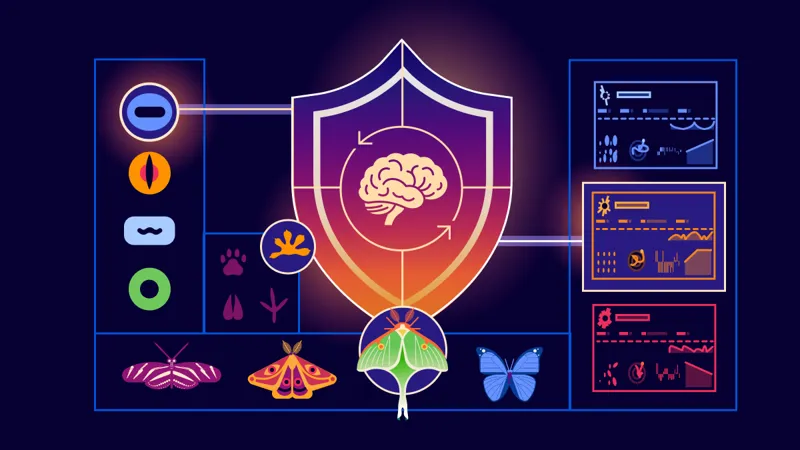
Cloudflare Adaptive Intelligence: Reversing Bot Attack Economics
Cloudflare introduces Adaptive Intelligence, a new bot detection engine designed to increase the economic cost for attackers and continuously adapt defenses.

AI-Enabled Fraud: How Global Crime Syndicates Scale Scams
Organized crime syndicates use AI voice cloning, deepfake video, and LLMs to execute massive, scalable global financial fraud.

Agentic AI in Cyber Defense: Boosting Blue Teams with Red Team Training
Researchers are leveraging agentic AI red teams to train and improve AI blue team defensive capabilities, addressing a historical offensive bias in AI cybersecurity.
Autonomous AI Models as Attackers: Securing Enterprise AI
Analysis of the emerging threat where an organization's own AI models act as autonomous attackers. Learn to secure enterprise AI models from such intrusions.
AI Surveillance Systems: Analyzing the Risks of Automated Enforcement
A technical evaluation of pervasive AI-powered surveillance, automated rule enforcement via machine learning, and the security implications of integrated data.
Quantifind Secures Funding for AI-Native Risk Intelligence Expansion
Quantifind's $200M funding will accelerate its AI-native risk intelligence platform, enhancing capabilities for financial crime detection and compliance globally.
OpenAI's GPT-5.6 Sol: Implications for Cybersecurity AI
OpenAI unveils GPT-5.6 Sol, touted as its most advanced cybersecurity AI, matching rivals while using fewer tokens. We analyze its potential impact.

Google Vertex AI SDK Model Hijacking via Bucket Squatting
A Google Cloud Vertex AI SDK vulnerability allows attackers to hijack model uploads and achieve RCE through bucket squatting and malicious Pickle files.
AI Cryptanalysis of Historical Ciphers: Implications for Security
Researchers use machine learning to automate the decryption of medieval ciphers, signaling a shift in how legacy encryption and manual schemes are analyzed.
Military AI Integration: Strategic Risks and Technical Guardrails
Analyze the Pentagon's acceleration of battlefield AI and the technical risks of autonomous systems, highlighting the need for human-centric oversight.

AI BOMs in Security: CISO Guide to Usability & Influence
Explore how CISOs can effectively prepare for and integrate AI Bill of Materials (AI BOMs) into their modern security programs, influencing their generation for better…

AI & Threat Intelligence: Reshaping Cyber Defense Efficiency
Explore how artificial intelligence, when fused with robust threat intelligence, redefines efficiency in cyber defense operations, empowering security teams.

AI's Rapid Reshaping of Cybersecurity Operations & Future Threats
Analysis from RSAC 2026 on AI's accelerating influence across cybersecurity, detailing its role in threat detection, defense, and emerging attack vectors.
Depthfirst's $80M Funding: Advancing AI in Threat Detection
Depthfirst secured $80M in Series B funding to advance AI research, develop security models, and scale enterprise adoption.

AI in Cybersecurity: Shifting Focus Beyond Historical Threats
Cybersecurity teams must broaden their threat intelligence scope, moving beyond historical threat actors to anticipate novel AI-driven attack vectors and future threats.

AI Digital Twin Security Implementation for Enterprise Threat Hunting
JPMorgan Chase uses digital twins and fingerprints to model 300,000 users, reducing false positives and automating detection in high-volume environments.